Saturday, 18 July 2020

ART LOST FOREVER – AN UNFATHOMABLE LOSS TO CIVILIZATION – Part 3


Works of art are a statement of and a commentary on the time, place and persons who created them and patronized them. They are the images of the civilization gone bye and help us to understand history. Although we may not realize it, art is a cultural statement that remains to inform and educate future generations of how life once was. This is what makes certain pieces of art more poignant and famous than others, when they come to symbolize a generation or period of time.

Though priceless and invaluable there have been occasions in history when they were not shown the respect they deserved and they were pillaged, plundered, stolen and destroyed. Thus either unknowingly or worse still, knowingly and with a vengeance of intolerance they have been destroyed and left gaping holes in the story of our civilization. So whether it was because of the World Wars or it was the plunder of Muslim fundamentalists of ISIS or Taliban, many precious works of art were lost forever. Accidents, fire, negligence and botched up restoration efforts too have contributed to the tragic loss of priceless artworks.

The wars have had a very detrimental impact on culture and civilization and art which remains an embodiment of both has suffered most and many epics have been lost forever. The invading armies were either ignorant of their true value or were so afraid of their potential to revive a culture that they purposely destroyed them.

When properly taken care of, works of art can persist through millenniums that tell the stories of the times passed to future generations. To preserve cultural heritage from getting destroyed, art galleries and museums have installed a set of rules designed to protect the artworks from thieves, vandals, and accidents. Artworks are often protected by safety ropes that keep the visitors at a reasonable distance. Some pieces are placed inside bulletproof glass boxes.

But, since art venues are trying to keep the sense of accessibility, many works are showcased without these protective items. Instead, they are guarded by a series of guidelines that the visitors must obey. For instance, viewers are often asked to leave their belongings (such as briefcases and umbrellas) at the front desk. Since children are prone to accidents of all kinds, museums demand that they must be accompanied by adults. Food and drinks are not allowed and touching the pieces is strictly forbidden.

There's a reason why museums and galleries ask people not to touch works on display. Human skin carries natural oils and acids that are harmful to artworks. A single touch can initiate permanent changes, darken the paint or corrode metal. But despite these rules, accidents happen and artworks get shattered, punched through or completely destroyed.

In a 5 part series I will be presenting 50 priceless and invaluable works of art which we will never be able to see again because they have been lost forever and this is the third series of 10 such masterpieces:


21. Man at the Crossroads - Diego Rivera

Diego Rivera painted many populist murals and frescoes, but his most famous work might be the one that no longer exists. In 1932, the artist was commissioned by John D. Rockefeller to create a mural for the walls of New York’s Rockefeller Center in 30 Rockefeller Plaza. Given the theme of “Man at the Crossroads Looking with Hope and High Vision to the Choosing of a New and Better Future,” Rivera responded with a revolutionary work that referenced scientific progress, civil rights and the plight of the working class. An ardent leftist, he also included a depiction of the communist leader Vladimir Lenin—a move that offended the sensibilities of his wealthy patrons. When Rivera refused to remove Lenin from his mural, the Rockefellers had the work covered over with canvas frames and then later destroyed. Rivera would go on to paint another version of his Rockefeller mural—this time titled “Man, Controller of the Universe”—in Mexico City.

Image may contain: 1 person

The controversy over the mural was significant because Rivera's communist ideals contrasted with the theme of Rockefeller Center, even though the Rockefeller family themselves admired Rivera's work. As originally installed, it was a three-paneled artwork. A central panel depicted a worker controlling machinery. The central panel was flanked by two other panels, The Frontier of Ethical Evolution and The Frontier of Material Development, which respectively represented socialism and capitalism.
The Rockefeller–Rivera dispute has become an emblem of the relationship of politics, aesthetics, creative freedom and economic power.


22. Medusa Shield - Leonardo da Vinci

Several of Leonardo da Vinci’s works have been lost to time, but the “Medusa Shield” is perhaps the most mysterious. Painted when the Italian master was in his youth, this early work supposedly took the form of a shield emblazoned with a creature inspired by the snake-haired Greek monster Medusa. According to a 1550 account by art historian Giorgio Vasari, the painting was so realistic that it initially frightened Leonardo’s father, who considered it a macabre masterpiece and secretly sold it to a group of Florentine merchants. The shield has long since vanished, and some modern experts now argue that Vasari’s account may have been little more than a myth.

Image may contain: 1 person

The head of a Medusa, with the head attired with a coil of snakes, the most strange and extravagant invention that could ever be imagined, but since it was a work that took time, it remained unfinished, as everything happened with almost all Leonardo's creations. Vasari indicates that the face was painted on a wooden shield cut from fig trees. It was a favor to a peasant friend of his who fashioned the shield. Leonardo in his experimental style took the shield and heated it by fire and made it smooth. He then moved to make one his very first masterpieces.


23. Chez Tortini - Edouard Manet

If you want to carry out an audacious art heist in the city of Boston, Massachusetts, then there’s no better time than St. Patrick’s Day. It was on that day in 1990, when almost all of the city was celebrating their Irish heritage, that Chez Tortini, along with a number of other artworks were taken from the Isabella Stewart Gardner Museum. As with all the other works, the whereabouts of Edouard Manet’s famous portrait of an unidentified gentleman remains a mystery, despite the fact the gallery is offering a $5 million reward for its safe return.


It’s believed that French artist Manet completed this oil on canvas painting in 1879 or 1880. Apart from that, little is known about it. Above all, while it’s made clear that the portrait is set in the CafĂ© Tortoni de Paris, a favorite hangout of the French realist, the subject of the work is never revealed. That is, nobody knows for sure whether it’s a portrait of one of Manet’s friends, relatives or simply a stranger he wanted to paint. Quite possibly, the man in question was a fellow Bohemian, quite possibly an artist or a writer. But what is for certain is that Chez Tortini is missing, presumed gone for good.

Other famous Manet paintings are 'Barque of Dante', 'Christ the Gardener', 'The Spanish Singer' and 'Olympia'.


24. The 16 Pleasures - Marcantonio Raimondi

The 16 Pleasures by Marcantonio Raimondi was so sexually scandalous that the Pope tried to destroy all the copies, though whether he succeeded or not is up for debate. The world’s first collection of pornography wasn’t so much lost or stolen as confiscated.

Marcantonio Raimondi’s series of erotic engravings both titillated and scandalized polite society at the peak of the Renaissance. In fact, it shocked the Catholic Church so much that they tried to buy up all the copies of the first edition of the work and have them all destroyed. Whether the Church succeeded in its puritanical mission, or whether one or more copies of the original survived the puritanical purge and are still out there, remains a source of considerable scholarly debate to this day.

The artwork, entitled The Sixteen Pleasures, or sometimes referred to as I Modi (The Ways) was actually a series of engravings created by Raimondi and then released in 1524. All of the elaborate engravings depicted different sexual acts and positions. Significantly, while other artists had made similar erotic works for private viewing, Raimondi intended his to be seen by the public. When Pope Clement VII learned of this, he was incensed. Wielding his Papal authority, he ordered his soldiers to locate and then destroy every set of the engravings. According to most accounts, they succeeded, and the Pope even had the artist briefly imprisoned.

Image may contain: 1 person, sitting

But that doesn’t mean that the puritans had the last word. Within a few years, a second edition had been published. This time, the engravings were accompanied by erotic poems. What’s more, Raimondi’s legacy lived on. In the 17th century, enterprising printers at Oxford University in England made copies of their own, bringing The Sixteen Pleasures to a new generation. These examples still survive today. However, the hunt for the original 1524 artworks goes on.


25. The Poor Poet - Carl Spitzweg

It was reportedly Hitler’s favorite painting. Painted in 1839, Carl Spitzweg’s The Poor Poet was very much a product of its time. In it, the artist satirizes the bohemian gentlemen who felt they needed to suffer for their art. In its day, it was hugely popular, transforming Spitzweg from a pharmacist who painted in his spare time, to one of the most acclaimed artists in Germany. And while the Fuhrer’s admiration undoubtedly tarnished its reputation – after all, Hitler hardly had good taste in art, despite his pretenses – it remained popular. So popular, in fact, that it has been stolen not once but twice. 

On the first occasion, in 1976, a German performance artist stole The Poor Poet from off the walls of the New National Gallery in Berlin. He was chased by the museum guards but managed to get into his car and drive away. He then drove to a working-class neighborhood of Berlin and hung the famous painting up on the wall of an immigrant family’s home. The stunt was designed to highlight the discrimination Turkish newcomers were facing in German society at the time. Regardless of whether or not he succeeded, the painting was quickly recovered and returned to the museum.

Image may contain: indoor

The painting was stolen again in 1989, however. This time, a visitor in a fake wheelchair managed to take this painting and another similarly small work by Spitzweg off the walls and smuggle them out right under the nose of the security guards. This time around, there was no happy ending. Neither of the paintings have been recovered. Moreover, since both works are compact and easy to hide, and since there was no CCTV back in 1989, it’s likely that Hitler’s favorite painting will remain missing, presumed lost for good. And, what’s more, these two aren’t the only Spitzweg paintings whose location is unknown. In all, some 36 works from the German artist’s vast output remain missing, almost all of them having been stolen.


26. Landscape with an Obelisk - Govert Flinck

For many years, Landscape with an Obelisk was attributed to the Italian master Rembrandt. After much investigation, however, it was determined that it was actually the work of Govert Flinck. Compared to the Italian, the Dutchman is quite little-known outside of his own country. And, sadly, this could remain the case, especially since this famous work of his was stolen from a Boston gallery in 1990 and is still missing.

The oil-on-wood painting, which depicts a pastoral landscape with a mysterious obelisk in the background, was finished in 1638. While it was inspired by the artist’s time in Rome, and in particular his time perfecting his craft in the ancient ruins of Tivoli just outside of the city, the exact location depicted is not clear. Regardless, at some point it was acquired by Isabella Stewart Gardner, one of the most notable American collectors and cultural philanthropists of the last century. She left it to the city of Boston and it hung in the Isabella Stewart Gardner Museum. And here it remained until March 1980, when the largest art theft in world history happened.


Landscape with an Obelisk was one of 13 paintings stolen that day. The total worth of the haul is believed to be around $500 million. The Flinck landscape on its own is worth in the region of $10 million, even if it lost some value after it was proven not to be the work of Rembrandt. Over the years, the finger of blame has been pointed at the Boston underworld. But even if local gangsters were behind the famous theft, it’s highly unlikely that they would risk trying to sell their half-a-billion-dollar haul. As such, Flinck’s most famous work will remain hidden from the public eye indefinitely, perhaps forever.


27. View of Auvers-sur-Oise - Paul Cezanne

View of Auvers-sur-Oise by Paul Cezanne was stolen in a perfectly-executed heist while the city of Oxford partied into the new millennium. The French artist Paul Cezanne never got around to signing or dating his landscape of the town of Auvers-su-Oise. Because of this, many art historians believe that the work was left unfinished. But that didn’t make it any less attractive to the thieves who struck on the eve of the Millennium. While the rest of Oxford was watching a fireworks display, the criminal – or criminals – broke into the city’s Ashmolean Museum and made off with the painting.

As Britain woke up from its big party the night before, news of the heist spread fast. It was revealed that the thief broke in through a skylight and used a rope to rappel down to the gallery floor. They then used a smoke bomb to obstruct the security cameras and then set off the fire alarm. All went to plan: the museum’s security guards waited for the fire brigade to arrive, giving the thief enough time to find the Cezanne, take it off the walls and then leave the museum the way he came in. The whole crime took less than ten minutes to carry out.


Police were soon on the scene. Since the same gallery was home to several other valuable works, investigators concluded that the thief stole the painting to order, making the task of recovering it even more difficult. So far, no trace has been found, either of the thief or of View of Auvers-sur-Oise. It’s believed that the painting would now be worth in excess of $10 million, making it one of the most valuable works of art ever stolen in Britain. Partly as a result of this single crime, the UK government passed a new law, deeming thefts of items deemed part of the British “national heritage” to be worthy of longer prison sentences than normal thefts.

This is ironical to say the least, several artefacts, sculptures and precious jewellery in the British museums are stolen from countries which were once British colonies including India!


28. En Canot - Jean Metzinger

En Canot by Jean Metzinger might have been stolen by a high-ranking Nazi, or it may have been burned a lot of other art the evil regime believed to be ‘degenerate’. Famously, the Nazis were quite hypocritical when it came to art. On the one hand, they were quick to condemn works painted by Jewish artists or by other so-called ‘degenerates’. On the other, however, they were more than happy to confiscate works by such artists, especially those worth large sums of money. Indeed, several prominent members of the Nazi regime would routinely ‘confiscate’ paintings and other works of art in the name of public decency, only to add them to their own personal collections. Which is precisely what’s likely to have happened to Jean Metzinger’s modernist masterpiece En Canot.

Frenchman Metzinger produced the piece in 1913. It depicts a woman, painted in a surrealist fashion, sitting in a canoe. Around her, waves are meant to give the viewer an unsettling feeling. The work painting was displayed in Paris that same summer and three years later it was acquired by Georg Muche. He agreed for En Canot to be displayed in a prominent gallery in Berlin, where it was then promoted to the German National Gallery. However, when the Nazis began their clampdown on art, it was confiscated. The painting was last seen in 1938, shown as part of the Degenerate Art Exhibition which toured Germany for three years.

No photo description available.

When the Nazi’s infamous traveling exhibition came to an end, many of the featured works were auctioned off to buyers in Switzerland, with all the money going to fund the regime’s war preparations. En Canot was not among them. It may be that a senior Nazi stepped in and took it for themselves – Hermann Goering, after all, took works by Vincent van Gogh and Paul Cezanne for his private collection, despite both artists having been labelled as ‘degenerate’ by the regime. Alternatively, it might have simply been destroyed. If it is ever found, Metzinger’s missing work would likely fetch more than $3 million at auction, not before it sparked a debate over who actually owns it, however.


29. Portrait of a Lady - Gustav Klimt

Portrait of a Lady is an oil on canvas painting by Gustav Klimt, painted between 1916 and 1917. The painting measures 60 by 55 centimetres. It depicts a portrait of a female figure, composed in an unusually lively expressionistic style.

Thanks to his massively-popular – and widely-reproduced – work The Kiss, Gustav Klimt is one of the best-known painters of all time. That also means that, as well as being popular with the viewing public, the Austrian’s paintings are also popular with art thieves, as an intriguing case from 1997 shows. It was like something straight out of a heist movie, with forgeries, ransom notes and intrigue extending all the way to the top of the Italian political system.

Later analysis revealed that the portrait was painted on top of an earlier portrait of one of the artist’s lovers who had died in tragic circumstances. The Galleria Ricci-Oddi in the Italian city of Piacenza acquired the painting as early as 1925 and it remained one of its highlights right up until February of 1997. Then, when the museum was due to host a special exhibition in order to celebrate the re-opening of one its galleries after renovation, Portrait of a Lady vanished.

Image may contain: 2 people

Several months later, Italian police made a startling discovery. They found a secret workshop where skilfully-made forgeries of the Klimt portrait had been produced. It’s now believed that the painting stolen on the eve of the museum’s special exhibition might not have even been the original. It could well be that Portrait of a Lady was taken and replaced with a forgery several months before the high-profile theft, with the second crime staged to distract from the earlier one. So far, no firm leads have been found, even though the thieves purportedly got in contact with the former Italian premier Bettino Craxi at one point. The Klimt remains missing.


30. The Royal Danish Egg - Peter Carl Fabergè

The Royal Danish egg (also known as the Danish Jubilee egg) is a jewelled enamelled egg a made under the supervision of the Russian jeweller Peter Carl Fabergè in 1903, for Nicholas II of Russia, who presented the egg to his mother, the Dowager Empress Maria Feodorovna. One of six Febergè eggs that are currently lost, it is one of two eggs whose existence is known only from a single photograph, the other being 1909's Alexander II Commemorative egg.

The egg contains miniature portraits of Christian IX of Denmark and his wife, Louise of Hesse-Kassel(or Hesse-Cassel), the parents of the Dowager Empress Maria Feodorovna. Miniatures of the late King of Denmark and his Queen are framed as the surprise feature in the Imperial egg. The outer surface is in light blue and white enamel with ornaments in gold and precious stones. On the top are the armorial bearings of the Danish Royal Family, and is supported by Danish heraldic lions.
One of the largest Fabergè eggs at over nine inches (229 mm) in height,the egg is crowned by the symbol of Denmark 's ancient Order of the Elephant.

No photo description available.

In 1903 the Dowager Empress Maria Fedorovna, born in Denmark as Princess Dagmar, returned to Denmark for the 40th Anniversary of her father's accession to the throne.The Royal Danish egg was thus a commemoration of this event and at the same time to commemorate the death of Queen Louise.
Nicholas II wrote to his mother in Copenhagen that he was "sending you a Fabergé Easter present. I hope it will arrive safely; it simply opens from the top.


We will continue with our journey through this tragic world of priceless works of art that are lost forever in our 4th  of the 5 series in the next blog


ART LOST FOREVER – AN UNFATHOMABLE LOSS TO CIVILIZATION – Part 2


Works of art are a statement of and a commentary on the time, place and persons who created them and patronized them. They are the images of the civilization gone bye and help us to understand history. Although we may not realize it, art is a cultural statement that remains to inform and educate future generations of how life once was. This is what makes certain pieces of art more poignant and famous than others, when they come to symbolize a generation or period of time.

Though priceless and invaluable there have been occasions in history when they were not shown the respect they deserved and they were pillaged, plundered, stolen and destroyed. Thus either unknowingly or worse still, knowingly and with a vengeance of intolerance they have been destroyed and left gaping holes in the story of our civilization. So whether it was because of the World Wars or it was the plunder of Muslim fundamentalists of ISIS or Taliban, many precious works of art were lost forever. Accidents, fire, negligence and botched up restoration efforts too have contributed to the tragic loss of priceless artworks.

The wars have had a very detrimental impact on culture and civilization and art which remains an embodiment of both has suffered most and many epics have been lost forever. The invading armies were either ignorant of their true value or were so afraid of their potential to revive a culture that they purposely destroyed them.

When properly taken care of, works of art can persist through millenniums that tell the stories of the times passed to future generations. To preserve cultural heritage from getting destroyed, art galleries and museums have installed a set of rules designed to protect the artworks from thieves, vandals, and accidents. Artworks are often protected by safety ropes that keep the visitors at a reasonable distance. Some pieces are placed inside bulletproof glass boxes.

But, since art venues are trying to keep the sense of accessibility, many works are showcased without these protective items. Instead, they are guarded by a series of guidelines that the visitors must obey. For instance, viewers are often asked to leave their belongings (such as briefcases and umbrellas) at the front desk. Since children are prone to accidents of all kinds, museums demand that they must be accompanied by adults. Food and drinks are not allowed and touching the pieces is strictly forbidden.

There's a reason why museums and galleries ask people not to touch works on display. Human skin carries natural oils and acids that are harmful to artworks. A single touch can initiate permanent changes, darken the paint or corrode metal. But despite these rules, accidents happen and artworks get shattered, punched through or completely destroyed.

In a 5 part series I will be presenting 50 priceless and invaluable works of art which we will never be able to see again because they have been lost forever and this is the second series of 10 such masterpieces:


11. Poppy Flowers - Vincent Van Gogh


Painted by Vincent Van Gogh, Poppy Flowers (also known as Vase and Flowers) was stolen from the Mohammud Mahmoud Khalil Museum in Cairo in August 2010. The painting depicts yellow and red poppy flowers against a dark background and is small in size, measuring just 65 x 54 centimeters. It is believed that Van Gogh painted this work three years before his suicide and that it was created out of Van Gogh’s admiration for Adolphe Montecelli.


With an estimated value of $50 million, it is no surprise that the painting was targeted by thieves. The robbery in 2010 wasn’t the first time the painting had been snatched; it was stolen from the same museum in June of 1977. Following an extensive search operation, it was found ten years later in Kuwait. A few hours after the second theft in 2010, Egyptian officials and police believed that they had discovered the painting at the Cairo International Airport when two suspects attempted to board a plane to Italy. However, this lead proved to be false, and the painting’s location is still unknown.


12. Le pigeon aux petits pois - Pablo Picasso

Painted in 1911, Pablo Picasso’s Le Pigeon aux Petits Pois (The Pigeon with Green Peas) became the target for a large art robbery in May of 2010. Swiped alongside four other masterpieces, Picasso’s painting was stolen from the MusĂ©e d’Art Moderne de la Ville de Paris. All five works have an estimated value of €100 million.


What was unusual about this theft was that it was carried out by one person instead of a gang of thieves, and all that was found at the crime scene was a broken padlock and a single smashed window. The paintings themselves were also removed from their frames rather than being cut. In 2011, a man who stated that he had thrown the painting into a rubbish container following the theft was convicted of the robbery. However, the credibility of this story is doubtful, and the painting is still lost.


13. The Storm on the Sea of Galilee - Rembrandt van Rijn

Another painting snatched in the same robbery as Joannas Vermeer's 'The Concert' was 'The Storm of the Sea of Galilee' by the Dutch golden age painter, Rembrandt van Rijn. This painting is believed to be Rembrandt’s only seascape. It depicts Jesus and the miracle of calming the Sea of Galilee from the Gospel of Mark. Painted in 1633, the painting is also amongst the most valuable missing artworks in the world.

Image may contain: sky

It was previously in the Isabella Stewart Gardner Museum in Boston but was stolen in March 18, 1990 and remains missing. The thieves came disguised as police officers.There have been recent developments related to the theft. In 2013, the FBI claimed that they knew the culprits of the crime and that the theft was carried out by a gang rather than one individual. However, there have been no other announcements about the case since then. There is a $5 million reward for information in relation to the robbery. The museum still displays the empty frames of the stolen paintings.


14. Nativity with St. Francis and St. Lawrence - Caravaggio

One of the most prolific artists in history, Caravaggio's works are among the most valuable in the world, and as a result, there have been a number of attempts by thieves to steal them. One successful theft occurred in 1969 when The Nativity with St. Francis and St. Lawrence (also known as The Adoration) was taken from the Oratory of San Lorenzo in Palermo, Sicily. The painting hung above the altar and was almost six square meters in size. The thief must have removed the painting from its frame due to its size. The Oratory was also pillaged of other artworks, precious woods and benches inlaid with mother of pearl. The location of the Caravaggio is still unknown to this day. It is believed that the local Sicilian Mafia carried out the theft, but this is just speculation. It is also rumored that the painting is hidden abroad or that it was destroyed during the theft or during the 1980 earthquake


Michelangelo Meris da Cparavaggio (1571 - 1610) was an Italian painter active in Rome most if his active artistic career but moved to Naples, Malta and Sicily later. His paintings combine a realistic observation of the human state, both physical and emotional, with a dramatic use of lighting, which had a formative influence on Baroque paintings.


15. The Portrait of a Young Man - Raphael

Snatched by the Nazis in Poland, the Portrait of a Young Man is believed to have been created by Raphael around 1513. It is often cited as one of the most important missing paintings since World War II. While the subject matter is disputed, it is generally regarded to be a self-portrait of Raphael, as the facial features are similar to those depicted in his self-portrait in the fresco 'The School of Athens'. The portrait shows a confident and well-dressed young man, depicted in an early Mannerist style. In 1939, the family patriarch Prince Augustyn JĂłzef Czartoryski rescued a number of pieces from the Czartoryski Museum, including Portrait of a Young Man. Despite being hidden, the collection was discovered by the Gestapo. The portrait was sent to Berlin and then Dresden to become part of the FĂĽhrer’s Collection at Linz. The last sighting of the painting was in KrakĂłw when it was placed in Wawel Castle. Its current location is still unknown. In 2012, a false report about the painting’s rediscovery was published but was soon ascertained to be a hoax.


Raffaello Sanzio da Urbino, known as Raphael, was an Italian painter and architect of the High Renaissance. His work is admired for its clarity of form, ease of composition, and visual achievement of the Neoplatonic ideal of human grandeur. His other famous works are Transfiguratio, La fornarina, The Marriage of the Virgin and Madonna del Prato.


16. Charing Cross Bridge - Claude Monet

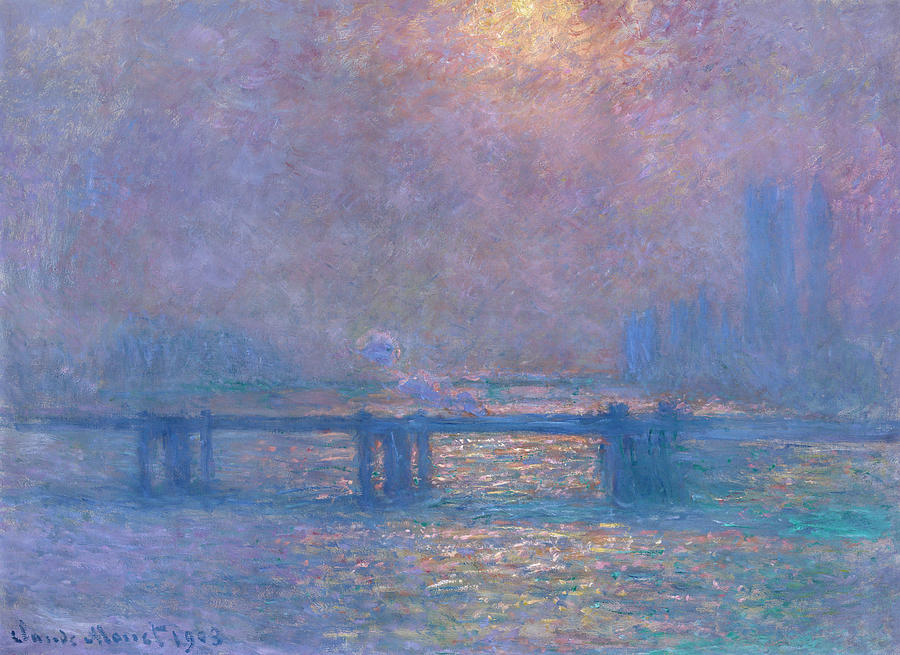
Between 1899 and 1904, Impressionist Claude Monet painted his famous series of Charing Cross Bridge in London, depicting the bridge over various times of the day and from different views. One of these paintings was stolen from Rotterdam as part of the Kunsthal Museum theft in October 2012. Following the theft, a group of Romanian thieves were convicted of the crime. One of the burglars claimed that the Monet painting, as well as a few other artworks that were stolen, was burned in his mother’s stove in order to hide any evidence of the theft. Following a search of the stove, traces of pigment were found, but there was not enough solid evidence to prove his claim. The painting is still listed as missing, and the investigation continues.


The Charing Cross Bridge paintings are scattered in collections all around the world. An unfinished canvas held by the Indianapolis Museum of Art. Other versions are at the Art Institute of Chicago, the Baltimore Museum of Art, the Museum of Fine Arts, Boston, the Harvard Museum of Fine Art, the Art Gallery of Ontario and the Thyssen-Bornemisza Museum in Madrid.

During the years between 1899 and 1905, Monet traveled to London to capture its sights from the fifth-floor balcony of the Savoy Hotel. Monet was captivated by the London fog made markedly worse by the heavy pollution of the Industrial revolution. He painted the Houses of Parliament, Waterloo Bridge and Charing Cross Bridge over and over again to reflect how the architecture changed with season and time of day.


17. Reading Girl in White and Yellow - Henri Matisse

Part of the same Rotterdam art heist in which Monet's Charing Cross Bridge was stolen was Reading Girl in White and Yellow by Frennch artist Henri Matisse. Painted in 1919, the painting depicts a woman deep in thought reading a book, sitting next to a table decorated with flowers. The theft of this artwork and the others stolen in the robbery was one of the biggest in The Netherlands in over a decade. The burglars broke into the museum through an emergency exit and swiped a number of works before fleeing, all within two minutes. The mother of one of the thieves also claims that she was frightened following her son’s arrest, and so she buried the stolen artworks in an abandoned house and a cemetery in the village of Caracliu. She later dug up the paintings and burned them in her stove. The Matisse painting and the other stolen works formed part of the Triton Foundation collection.

Image may contain: 1 person, standing

Henri Émile Benoît Matisse was a French artist, known for both his use of colour and his fluid and original draughtsmanship. He was a draughtsman, printmaker, and sculptor, but is known primarily as a painter. He was a leading figure of Fauvism and, along with Pablo Picasso, one of the most influential artists of the modern era. In his paintings, sculptures, and works on paper, Matisse experimented with vivid colors, Pointillist techniques, and reduced, flat shapes. His other famous works include Blue nudes, Woman with a hat and the snail.


18. Francis Bacon - Lucian Freud


Missing since 1988, the portrait of Francis Bacon by Lucian Freud was taken from Berlin's Neue Nationalgalerie, possibly by a fan of Bacon or a student. The gallery was full at the time of the theft. Following the robbery, Freud designed his own wanted poster for the stolen portrait, but this didn’t garner any responses. The poster depicts a monochrome version of the painting with ‘wanted’ in red as well as a reward. The stolen painting was created over half a century ago and reveals Freud and Bacon’s close friendship. The portrait was praised for its intimate nature and tension. At the time of the theft, the portrait was on loan from the collection at the Tate for a retrospective on the artist at the Berlin gallery. There has been information regarding the portrait since the theft.
Image may contain: 1 person

For a quarter of a century, Lucian Freud and Francis Bacon were the closest of friends. Their lives were characterized by an intense mutual scrutiny of each other and each other’s work, resulting in some extraordinary paintings and a deep but volatile relationship.

When they weren’t painting, they spent much of their time at the Gargoyle Club (and later the Colony Room) in London’s Soho, drinking, gambling and arguing.

19. The Stone Breakers - Gustave Courbet


Painted in 1849, this classic example of social realism was hailed for its unsentimental depiction of poor laborers, one young and one old, removing rocks from a roadside. Inspired by a chance meeting with two downtrodden workers, French artist Gustave Courbet deliberately broke with convention by capturing the men in gritty detail, from their straining muscles to their tattered and dirty clothing. While it helped launch Courbet’s art career, “The Stone Breakers” was ultimately doomed to become one of the many cultural casualties of World War II. In 1945, the painting was destroyed during an Allied bombing near the city of Dresden, Germany

Image may contain: one or more people 
If we look closely at the painting, painted only one year after Karl Marx and Friedrich Engels wrote their influential pamphlet, The Communist Manifesto, the artist's concern for the plight of the poor is evident. Here, two figures labor to break and remove stone from a road that is being built. In our age of powerful jackhammers and bulldozers, such work is reserved as punishment perhaps. The man that seems too old and the boy that seems still too young for such back-breaking labor is meant to be an accurate account of the abuse and deprivation that was a common feature of mid-century French rural life.
Jean Désiré Gustave Courbet was a French painter who led the Realism movement in ... 'The Painter's Studio', 'The Desperate Man', 'The Wounded Man', 'Woman with a parrot' and 'A Burial at Ornans'.


20. The Buddhas of Bamiyan


Built sometime in the 6th century, this legendary pair of stone Buddhas stood for 1,500 years before falling victim to a cultural purge by the Taliban. The 135 and 175-foot-tall carvings were originally fashioned directly out of a sandstone cliff, and served as Bamiyan’s most spectacular monument during a time when the city flourished as a Silk Road trading hub. While they weathered more than a dozen centuries, several attacks by Muslim emperors and even an invasion by Genghis Kahn, the Buddhas were finally destroyed in March 2001, when the Taliban and their allies in Al Qaeda gave an order condemning idolatrous imagery. Ignoring widespread appeals from the international community, the groups then fired on the statues with antiaircraft guns before blowing them to rubble with dynamite. While the destruction of the Buddhas was condemned as a crime against culture, a number of formerly hidden cave drawings and texts have been discover among the debris, and in 2008 archaeologists unearthed a third, previously undiscovered Buddha statue near the ruins.
 Image may contain: one or more people
Bamiyan valley is 230 Km north east of Kabul and the statues were classic example of Gandhar art and an UNESCO world heritage site. The statues consisted of the male Salsal ("light shines through the universe") and the (smaller) female Shamama ("Queen Mother"), as they were called by the locals. The main bodies were hewn directly from the sandstone cliffs, but details were modeled in mud mixed with straw, coated with stucco. This coating, practically all of which wore away long ago, was painted to enhance the expressions of the faces, hands, and folds of the robes; the larger one was painted red and the smaller one was painted multiple colors.


We will continue with our journey through this tragic world of priceless works of art that are lost forever in our 3rd of the 5 series in the next blog
ART LOST FOREVER - AN UNFATHOMABLE LOSS TO CIVILIZATION


Works of art are a statement of and a commentary on the time, place and persons who created them and patronized them. They are the images of the civilization gone bye and help us to understand history. Although we may not realize it, art is a cultural statement that remains to inform and educate future generations of how life once was. This is what makes certain pieces of art more poignant and famous than others, when they come to symbolize a generation or period of time.

Though priceless and invaluable there have been occasions in history when they were not shown the respect they deserved and they were pillaged, plundered, stolen and destroyed. Thus either unknowingly or worse still, knowingly and with a vengeance of intolerance they have been destroyed and left gaping holes in the story of our civilization. So whether it was because of the World Wars or it was the plunder of Muslim fundamentalists of ISIS or Taliban, many precious works of art were lost forever. Accidents, fire, negligence and botched up restoration efforts too have contributed to the tragic loss of priceless artworks. 

The wars have had a very detrimental impact on culture and civilization and art which remains an embodiment of both has suffered most and many epics have been lost forever. The invading armies were either ignorant of their true value or were so afraid of their potential to revive a culture that they purposely destroyed them.

When properly taken care of, works of art can persist through millenniums that tell the stories of the times passed to future generations. To preserve cultural heritage from getting destroyed, art galleries and museums have installed a set of rules designed to protect the artworks from thieves, vandals, and accidents. Artworks are often protected by safety ropes that keep the visitors at a reasonable distance. Some pieces are placed inside bulletproof glass boxes.

But, since art venues are trying to keep the sense of accessibility, many works are showcased without these protective items. Instead, they are guarded by a series of guidelines that the visitors must obey. For instance, viewers are often asked to leave their belongings (such as briefcases and umbrellas) at the front desk. Since children are prone to accidents of all kinds, museums demand that they must be accompanied by adults. Food and drinks are not allowed and touching the pieces is strictly forbidden.

There's a reason why museums and galleries ask people not to touch works on display. Human skin carries natural oils and acids that are harmful to artworks. A single touch can initiate permanent changes, darken the paint or corrode metal. But despite these rules, accidents happen and artworks get shattered, punched through or completely destroyed.

In a 5 part series I will be presenting 50 priceless and invaluable works of art which we will never be able to see again because they have been lost forever and this is the first series of 10 such masterpieces:

1. Le Peintre by Pablo Picasso

One of the most famous paintings by the modern art world's beloved creator, this 1963 painting entitled "Le Peintre" (The Painter) was lost in a 1998 crash of Swissair Flight 111 off of Halifax, Nova Scotia. At the time of the crash, the painting was valued at about one and half million dollars. "Le Peintre" was part of a famous series in Picasso's revolutionary 'Blue Movement'.
No photo description available.

An artist stares contemplatively at his canvas in Pablo Picasso Le Peintre (The Painter), 1963 as he lifts his brush to the surface. There is intensity in his brow line, and his expression is serious. Wild lines make up his beard, adding an element of frenzy to the creative process. The hand of the man also contains movement – Picasso has layered multiple outlines of the hand to create this motion to and fro across the canvas. The use of hand applied Pochoir makes this a very special work, giving the appearance of watercolor. It adds a lovely texture and complexity to the collotype.


2. The Fourteen Paintings by Gustav Klimt


Gustav Klimt was an Austrian symbolist painter in the mid to late 19th century whose work focused on the female form and were noted for their eroticism. Serena Lederer was a wealthy Viennese art collector and a prominent member of Austria society who collected fourteen of Klimt's paintings that came to be known as the Fourteen Paintings. In 1943, Lederer sent the paintings to the Schloss Immendorf museum for safe keeping during the war, however the opposite occurred. The Nazi Party set fire to the Schloss Immendorf Museum in 1945, ruining all of Lederer's Klimt works along with thousands of other pieces of art.
Image may contain: 1 person

Gustav Klimt ‘s most famous work is The Kiss'. To me it is far more fascinating than a rather underwhelming Monalisa. It is the final painting of Klimt's Gold Period, during which he incorporated gold leaf into his works. This practice reflects the strong influence of the gold-detailed religious art of the Middle Ages as well as the sacred works created by artists of the Byzantine Empire. As a result, some considered such paintings as "The Kiss" to be sacrilegious.
Gustav's uncle Earnst had a metalwork in which Gustav worked when he was young. He learned the artistic use of metals in his early days. Though both figures in 'the kiss' are fully clothed still it exudes eroticism. It is no coincidence that Klimt's work is often linked to that of his Viennese compatriot, and near-contemporary, Sigmond Freud. This oil painting with gold leaf metal work is in Belvedere museum housed in the Belvedere palace, in Vienna, Austria.


3. Water Lilies – Oscar Claude Monet

Oscar Claude Monet was a French painter, a founder of French Impressionist painting and the most consistent and prolific practitioner of the movement's philosophy of expressing one's perceptions before nature, especially as applied to landscape painting. In fact the term "Impressionism" is derived from the title of his painting 'Impression, soleil levant' or Impression Sunrise.

Image may contain: water, outdoor and nature

One of Claude Monet's most famous works of the impressionist movement the Water Lilies series. Two of the paintings from the series were destroyed by fire in the Museum of Modern Art (MoMA) in New York City in 1958. The entire Water Lillies series was completed by Monet in 1883 and contained over 250 oil paintings, and which were also painted while Monet was suffering from cataracts. In April, 1958, a fire broke out on the second floor of MoMA, which was supposedly set off by a worker who lit a cigarette too close to paint cans and canvas.


4. Leda and the Swan by Michelangelo

The Greek myth of Leda and the Swan was painted into life by Michelangelo around 1530. In the story of Leda and the swan, the Greek god Zeus appears in the form of a swan and rapes and seduces Leda. From that encounter, Helen and Polydeuces are born, the former to later become the reason for the Trojan War. According to the story, Michelangelo gave the painting to his friend and student, Antonia Mini, who then took the painting with him to France. There, Mini may have sold the painting because it was last seen in the royal collection of Fontainebleau in 1530. The court painter, Rosso Fiorentino, painted a copy of it and it is the only copy that still remains, besides Peter Paul Rubens reproduction of it.

No photo description available.

Not only Michelangelo but even poet William Butler Yeats was moved by this story and composed this famous poem:
Leda and the Swan
A sudden blow: the great wings beating still
Above the staggering girl, her thighs caressed
By the dark webs, her nape caught in his bill,
He holds her helpless breast upon his breast.
How can those terrified vague fingers push
The feathered glory from her loosening thighs?
And how can body, laid in that white rush,
But feel the strange heart beating where it lies?
A shudder in the loins engenders there
The broken wall, the burning roof and tower
And Agamemnon dead.
Being so caught up,
So mastered by the brute blood of the air,
Did she put on his knowledge with his power
Before the indifferent beak could let her drop?


5. Mississippi River Panorama - John Banvard

John Banvard was an American panorama and portrait painter best known for his panoramic views of the Mississippi Valley. In 1840, the New York-born artist spent months traveling up and down the Mississippi River in a boat to sketch and take in the scenery. Eventually, he transferred his sketches to a large canvas which he then beautifully painted. It is believed that the finished work measured 12 feet high and a mile and a half long, and toured the United States in the mid-19th century. He even took it to different cities of Europe and held a special exhibition exclusively for the British Queen. Towards the end of the 19th century, the panorama was cut into several pieces for storage and some of those pieces have never been recovered.


Such was the popularity of the painter that during World War II, a Liberty Ship was named the S.S. John Banvard.

Panoramic paintings are massive artworks that reveal a wide, all-encompassing view of a particular subject, often a landscape, military battle, or historical event. They became especially popular in the 19th century in Europe and the U.S. but only a few have survived into the 21st century and are on public display.


6. The painter on his way to work - Vincent Van Gogh

Another of the world's infamous modern artists and the creator of the famous Starry Night, this painting was finished in July of 1888, just two years before the artist's death. Of the nearly two thousand works of art completed in Van Gogh's life time, this is one of six that has disappeared. The painting was housed at the Kaiser-Friedrich Museum, which was destroyed by fire in the Second World War. The painting is believed to be one of Van Gogh's many self-portraits, in which he is carrying his painting supplies in Montmajour.

No photo description available.

It is part of several paint studies that he sent to his younger brother Theo. This self-portrait is very different from his others, in which he typically depicted himself as seated with a plainer background, showing only his torso and face. In this painting, he is full-bodied, trudging along the road to work with his cane and art supplies. The figure is paused mid-step, suggesting that he stopped his busy pace to see if this was the place to paint. Much of his painting took place outdoors, travelling from area to area for new subjects. His face is obscured, giving the impression that he is part of the surrounding countryside. It is inferred that the figure is Van Gogh by the red hair peeking out below the straw hat.


7. Spring - Jean Antonie Watteau

Known as the rejuvenator of the Baroque style, Watteau was a well-known French painter in the early 18th century. In 1716, Watteau painted a series of seasonal images for Pierre Crozat, a prominent French art collector, entitled Spring (Printemps), Autumn, Winter, and Summer. Of the four seasonal paintings, only one remains today. Spring was magically rediscovered in 1964, only to be destroyed by fire just two years later, and Autumn and Winter have never been found.

Image may contain: one or more people

Little known during his lifetime beyond a small circle of his devotees, Watteau was mentioned but seldom in contemporary art criticism and then usually reprovingly. Some of his famous works are Polish woman standing, in Warsaw National museum, A Puerto, Mezzetino in Louvre Paris and The hunter; in National Gallery of Scotland.


8. Portrait of Winston Churchill - Graham Sutherland

In 1954, the artist Graham Viivian Sutherland was commissioned to paint a full-length portrait of Winston Churchill in celebration of is 80th birthday. Sutherland was considered a 'moderate painter' and was known for capturing the 'real side' of his subjects, which is why the House of Commons and House of Lords donated money to have the painting done in 1954. Yet Sutherland's true-to-life style was not so appreciated by Churchill himself, nor his wife, and after the public presentation, it was never officially displayed. In 1977, following Lady Churchill's death, it was discovered that she had destroyed the painting upon receiving it.


Sutherland was famous for his work on glass, fabric, prints and portraits so he was a painter, etched and designer. He taught at a number of art colleges, notably at Chelsea School of Art and Goldsmiths College and was the official war artist of Second World War.


9. The Concert - Johannes Vermeer

Painted in 1664 by the famous Dutch painter Johannes Vermeer, The Concert depicts a man and two women playing music. It belonged to the Isabella Stewart Gardner Museum in Boston, but in one of the most famous art heists in history, was stolen in 1990 and remains missing. The estimated value of the painting is about $200 million, thought to be one of the most valuable unrecovered stolen paintings. The thieves were believed to be disguised as police officers, and stole 13 more works of art from the museum, including Rembrandt's "The Storm of the Sea of Galilee".

Of three musicians in the oil painting a young woman is sitting at a harpsichord a man is playing the lute and a woman .is singing. The harpsichord's upturned lid is decorated with an Arcadian landscape; its bright coloring stands in contrast to the two paintings hanging on the wall. The musicians' clothing and surroundings identify them as members of the aristocracy.


Interestingly of the two paintings in the background, the one on the right is The Procuress by Dirck Van Baburen (c. 1622), which belonged to Vermeer's mother-in-law, and it has appeared in his yet another masterpiece 'The Lady Seated at a Virginal'.


10. The Colossus of Rhodes - Charles of Lindos

The Colossus of Rhodes was a statue of the Greek Titan Helios, the personification of the sun, on the island of Rhodes, constructed by artist Charles of Lindos in 280 BC. The statue, which was destroyed in the earthquake of 226 BC, stood over 30 meters (98.4 feet) high and was one of the tallest statues in the ancient world. Until today, it is considered one of the Seven Wonders of the Ancient World, constructed to celebrate the victory of Rhodes over Demetrius, the ruler of Cyprus in 305 BC.

No photo description available.

Construction began in 292 BC. Ancient accounts, which differ to some degree, describe the structure as being built with iron tie bars to which brass plates were fixed to form the skin.Much of the iron and bronze was reformed from the various weapons Demetrius's army left behind, and the abandoned second siege tower may have been used for scaffolding around the lower levels during construction. Upper portions were built with the use of a large earthen ramp. During the building, workers would pile mounds of earth on the sides of the colossus. Upon completion all of the earth was removed and the colossus was left to stand alone.

Preserved in Greek anthologies of poetry is what is believed to be the genuine dedication text for the Colossus:
To you, O Sun, the people of Dorian Rhodes set up this bronze statue reaching to Olympus,
when they had pacified the waves of war and crowned their city with the spoils taken from the enemy.
Not only over the seas but also on land did they kindle the lovely torch of freedom and independence.
For to the descendants of Herakles belongs dominion over sea and land.

Let us continue our journey through the world of priceless lost art treasures in 2nd part of this series.

Thursday, 16 July 2020

HAGIA SOPHIA – CHANGING WITH CHANGING TIMES


Istanbul or Constantinople, as it was once called, is a major city in Turkey that straddles Europe and Asia across the Bosphorus Strait. Its Old City reflects cultural influences of the many empires that once ruled here. In the Sultanahmet district, the open-air, Roman-era Hippodrome was for centuries the site of chariot races, and Egyptian obelisks also remain. The iconic Byzantine Hagia Sophia features a soaring 6th-century dome and rare Christian mosaics. The mystical city Istanbul hosted many civilizations since centuries, of which Byzantium and Ottoman Empires were both the most famous ones. The city today carries the characteristics of these two different cultures and surely Hagia Sophia is a perfect synthesis where one can observe both Ottoman and Byzantium effects under one great dome. It is one of the magnificent landmarks in Istanbul’s historical centre.

Some cities just have travel in their blood. You can feel their spirit of adventure pulsing through invisible veins in the same way cars fill their streets and people pack their pavements and life roils and bubbles around you. Istanbul has travel in its soul. The world has come to Istanbul because Istanbul really was, once, the world. This coastal stronghold has a history as tattered and colourful as any other ancient city would die for. There's still an edge to the city too, as there is in any border post, particularly one that marks the end of one continent and the beginning of another; the end of one world and the start of a whole new universe. But that's part of Istanbul's charm, part of the feeling that the whole world is here, and that it's welcome to make its mark.

The Hagia Sophia, is part of the UNESCO World Heritage site in Istanbul. Its name translates to “holy wisdom”, was built by the East Roman Empire in the 6th century. It was then converted into a mosque and fortified following Mehmed the Conqueror’s rule in 1453. One can admire this architectural wonder’s marbled structure, as well as its dreamy interiors. It features calligraphic panels and bronze lamps, and most of its walls are covered in beautiful mosaics made of gold, silver, and colourful stones. 

Hagia Sophia is the former Greek Orthodox Christian patriarchal cathedral, later an Ottoman imperial mosque and then a museum (Ayasofya MĂĽzesi) and now, by a court intervention and a hyper-nationalist government, again a mosque. It is said to be built on a site which originally had a Pagan temple dedicated to Venus and Apollo. It is famous for its large dome. Built in AD 537, during the reign of Justinian, it was the world's largest building and an engineering marvel of its time. The unfortunate decision of Turkey’s top administrative court to cancel Hagia Sophia’s museum status and reconvert it into a mosque has rightly been criticised all over the world.

The Eastern Orthodox Church, the sect to which Hagia Sophia originally belonged, has just 0.001 per cent share in the population of Turkey today. This is due to the Treaty of Lausanne signed in 1923, which ended Ottoman rule and led to an exchange of population between empires. It resulted in almost one million non-Muslims going to Greece, Armenia, and Muslims from these states settling in Turkey.

The original church to occupy the site (called the Megale Ekklesia or Great Church) was commissioned by Emperor Constantine I in 325, razed during a riot in 404, later rebuilt, and destroyed once again in 532.  The building that exists today, some historians believe that old pagan temples were destructed and the remains of them were used in new Christian structures. The upsided Medusa heads in Basilica Cistern are believed to have been taken from the closed Pagan temples.

Hagia Sophia was constructed by Emperor Justinian I between 532 and 537 AD and remained an Orthodox Christian church for almost 900 years. Although, in the middle, it was converted into a Roman Catholic Cathedral during the fourth Crusade of 1204, but it was converted into an Eastern Orthodox Church again when the Byzantine empire made a comeback in 1261. For almost a millennium after its construction, it was the largest cathedral in all of Christendom. It served as a center of religious, political, and artistic life for the Byzantine world and has provided us with many useful scholarly insights into the period.


After the fall of Constantinople in 1453, Ottoman Sultan Mehmat II converted it into a mosque by purchasing it and creating a waqf. Bringing the structure in line with the Islamic tradition called for a series of other modifications, not all of which were undertaken during the reign of Mehmed II. The Alter, the bells, sacrificial vessels and iconostasis were all removed when the church was converted into a mosque. Many Christian mosaics and frescoes were plastered over when Hagia Sophia converted in to a mosque by Sultan Mehmed II. There are 4 seraphim mosaics ( God's protector angels with 6 wings) on the 4 pendentives that carry the dome. The 4 seraphims' faces were covered with 6-7 layers of plaster for almost 160 years during the sovereignty of Ottomans. The last person who saw the faces of the Seraphims was the Swiss architect Gaspare Fossati while he was holding the restoration at Hagia Sophia in 1840s. With a 10 day hard work, experts managed to take off the 7 layers of plasters and reveal the face of one of the seraphims.

During Mehmed’s rule, a wooden minaret (no longer standing), a mihrab (niche positioned in the direction of Mecca), aminbar (pulpit), a madrasah (school), and a grand chandelier were added. Later modifications included the construction of more minarets, the whitewashing of Christian mosaics, and the addition of structural supports. There were two more Churches accepted as Church of Holy Wisdom, but only Hagia Sophia was not destroyed by Ottoman rulers.

Hagia Sophia remained a mosque until 1931 when it was closed. It was reopened as a museum in 1934 in a decision by the Turkish Republic’s first president Mustafa Kemal Ataturk cabinet. It was ‘secularised’ and opened to all with an entry fee. When Hagia Sophia was a church 50 foot silver iconostasis was decorating inside, later it was on display in the museum. Now, Turkey’s Council of State has ruled that this conversion to a museum was illegal.

Hagia Sophia is not, in fact, the only name that the structure has gone by. Even now it’s known by several different monikers: Ayasofya in Turkish, Sancta Sophia in Latin, and Holy Wisdom or Divine Wisdom in English (alternate English translations of the Greek words Hagia Sophia). The name Hagia Sophia didn’t come about until around 430 CE.

The Hagia Sophia combines a longitudinal basilica and a centralized building in a wholly original manner, with a huge 32-metre (105-foot) main dome supported on pendentives and two semidomes, one on either side of the longitudinal axis. In plan the building is almost square. There are three aisles separated by columns with galleries above and great marble piers rising up to support the dome. The walls above the galleries and the base of the dome are pierced by windows, which in the glare of daylight obscure the supports and give the impression that the canopy floats on air. Only Patheon in Rome has slightly bigger dome than the dome of Hagia Sophia in the world.  Hagia Sophia has 40 windows in the area where worshipers sit and it’s known as famous reflecting mystical light. The Blue Mosque and Sultan Ahmed Mosque in Istanbul were designed with an inspiration of Hagia Sophia.


Hagia Sophia become one of the leading artistic and architectural monuments in the world therefore attracting not only the tourists but also the historians, the architects, the artists and the archaeologists. Art historians consider the building’s beautiful mosaics to be the main source of knowledge about the state of mosaic art in the time shortly after the end of the Iconoclastic Controversy in the 8th and 9th centuries. Its architecture, its history, its grand magnificence and its functionality all makes it a prized world heritage site, too precious to be harmed by religious fundamentalism.